Like many of the traditions we’ve discussed so far, the Yule Log, which originally was an entire tree, not simply a branch or an large ivy wrapped log like below, originated in pagan celebrations, such as the Anglo Saxon fire ceremonies of the Winter Solstice and the Yule festivities of Scandanavian people. The Yule Log was brought into the home during the mid-winter festival, the large end set ablaze in the hearth. Our home is equipped with a woodburning fireplace, but while we do burn good-sized logs, I draw the line an an entire tree unless it’s been cut into suitable pieces.

Burning the Yule Log was popular not only in Scandanavia but in most of Northern Europe, including England, Scotland, Wales, and Ireland. The log served the dual purpose of celebrating the rebirth of the sun since the Winter Solstice, the darkest day of the year, usually December 21, had passed and to keep the fire burning while everyone overindulged in food and drink, feasting to excess. Since the log was so big, it lasted the entire period, meaning no one had to look after the fire while people celebrated. The Yuletime hangover was a real thing, heavily condemened by the early Christian church, but it wasn’t easy to stop people from enjoying themselves at the darkest time of the year.
As the Roman Empire grew, the Yule festivities merged with those of Saturnalia, the feast dedicated to the god Saturn, who was also the patron god of soldiers. Gradually Christianity replaced the old Roman religion, and in the fourth century when the Roman rulers created the Holy Roman Empire to spread catholicism, they dictated that December 25th would be the day they celebrated the birth of Christ. To make the new religion more palatable, they incorporated a number of pagan celebrations into the event– including the Persian festival honoring Mithra, the god of light and Saturn the god of agriculture. They even managed to place the Feast of Epiphany, the visit of the Magi on the twelth day of the pagan Yule celebration.
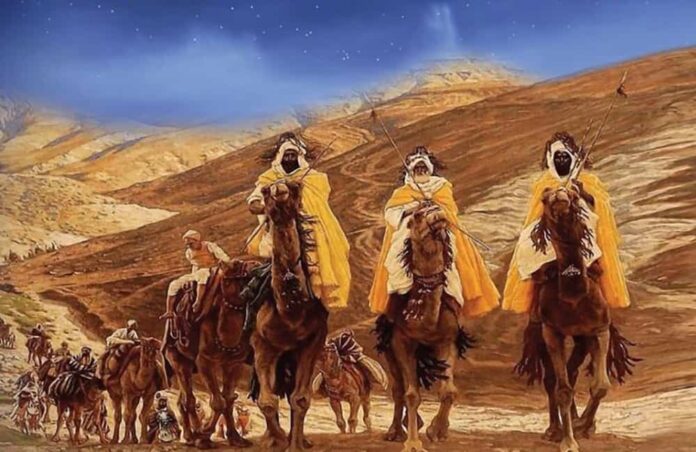
Throughout the Middle ages, people continued to use Yule Logs in various fashions. By the seventeenth century, celebrating the Twelve Days of Christmas, the period between the birth of Christ and the Magi’s arrival, and the Yule Log were very much an integral part of the Christmas celebration. Robert Herrick, a seventeenth century writer described the fanfare that surrounded the arrival of the yule log. In England, a group of young men would carry it into the house with ceremony and singing.
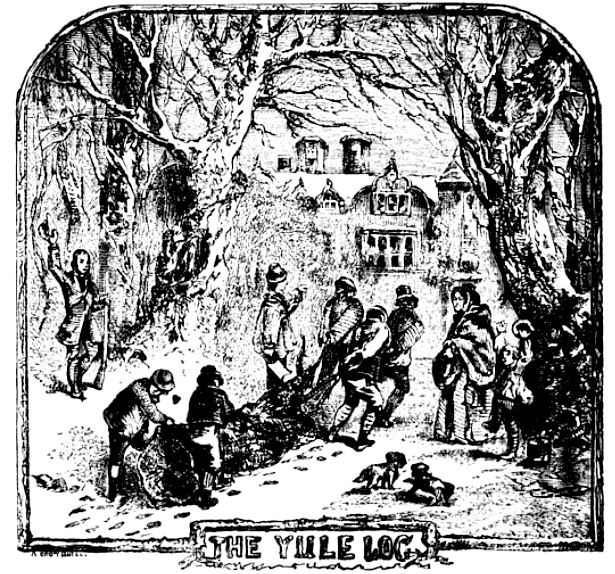
In parts of France, cutting down the tree to be used as the Yule Log was a family affair, with a small portion of the log burned each of the Twelve Nights. Whatever was left over from the log was taken out of the hearth after the last night and kept safe in the house until the next Christmas when it would be used as kindling for the new Yule Log. People believed the burned log would protect the house from lightning strikes and fire. In the Netherlands, the log was kept under the bed for good luck–not the safest practice I’m sure. The ashes were saved and come spring, they were scattered over the fields to protect the new plants and fertilize the soil.
None of this sounds very Christian. In truth, it wasn’t. Over the years, the practice of burning the Yule Log has changed. With the advent of different methods to heat the home, burning trees indoors wasn’t practical. Instead, the Yule Log became more ornamental. Instead of burning the log, candles are placed atop it and burned instead. The candles can be almost any color.
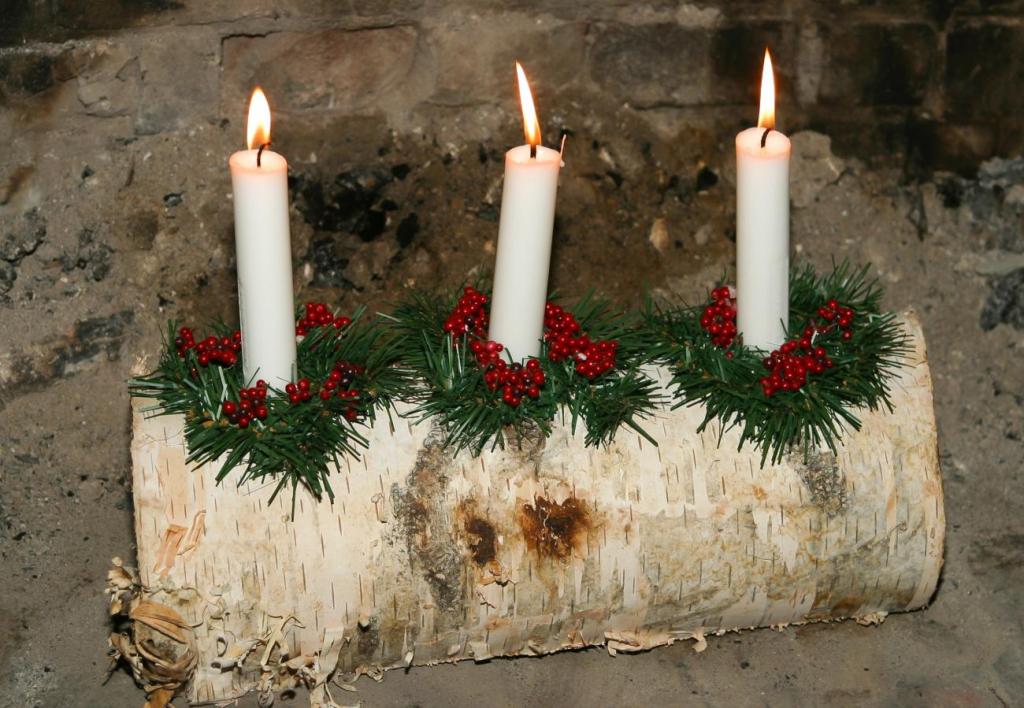
Like in the past, the candlelight celebrates the return of the sun and the longers days leading to the arrival of spring.
Today, to many people, the Yule Log is better known as Bûche De Noël, Yule Log, in French and a dessert enjoyed by many at Christmas. IInterested in making one of your own? Here’s a step-by-step demonstration.
So there you have today’s pagan celebration incorporated into Christmas. Come back tomorrow for another Christmas Fact.
I
 Living the Dream
You’ve really done your research for these fun Christmas Facts. Well done!
LikeLiked by 1 person
Thanks Trtisha.
LikeLiked by 1 person