Hard to believe we’re already into March. It seems as if the year just started, but I will be happy to see the end of winter this year. With COVID still on the rampage and other unsettling world and national events, it’s been hard to stay positive. I suppose like everyone else, this is the late winter slump, but it would be so nice to see normal again. Sadly, I’m not sure that will happen this year or even next.
This month’s IWSG blog question is – Have you ever been conflicted about writing a story or adding a scene to a story? How did you decide to write it or not?
With the onset of the pandemic, as a romance writer, I struggled with this because as a writer of contermporary fiction, the word contemporary to me means now. With lockdowns, masking, social distancing rules in place, I wondered how people met other people. For a long time bars, gyms, even cgurches were closed. The first pandemic book I wrote, I set the story fifteen years ago. That was fine, but it just couldn’t work all the time.
How did I deal with it? Well, I added the pandemic and all of its protocols to my books. Once we were allowed to go out again, we did so with rules–vaccines, masks,unless we were eating or drinking, social distancing, hand washing–you know the drill. It’s become part of my lifestyle, so much so that there’s an automatic quality to it. I get in the car, and put on my seatbelt. Now, when I get out of the car to go inside a store or a restaurant, I put on my mask. I step inside, I sanitize my hands. I decided if this was my real world, then it should be fictitious one, too. Not all of my author friends agree, and that’s okay. We are allowed to disagree. How boring the world would be if we all thought and did the same thing.
So, that’s my answer to this months question. My choice was to write books incorporating the pandemic. When and if things get back to normal in real life, I’ll do the same in my fictitious one.
Welcom to this week’s Tuesday Tales. I blinked and it was winter, I blinked again and spring is only three weeks away. Happy March! This week’s Tuesday Tales, taken once more from Sea Breeze, is based on the word GRAY.
Opening the door, I yelped. What the hell? Maybe I’d been wrong, and Cal did live with his mother, because the woman standing before me in the hall, like a security guard at the mall, looked a hell of a lot like him. Either that, or the place was haunted. I didn’t like my odds either way.
The heavyset woman in a cotton, short sleeved dress, appeared to be around the same age as my mother. Her short hair was gray-streaked brown, her brown eyes twinkled, and a knowing smile twisted her mouth. A dimple similar to Cal’s cratered her right cheek. She stood there, staring at me, examining me as if I was the prize turkey in the butcher’s window, all the while holding my clean sundress on a hanger and my bra and thong hanging from the fingers of her other hand.
Lord, kill me now.
I faced her, my heart pounding as madly as that of a kid caught with his hand in the cookie jar. I stared at my red thong hanging from her index finger next to my white lace bra. Why was it that none of my underwear ever matched? While I’d never actually done the walk of shame, and certainly hadn’t done anything this time to deserve it, the burn of a blush started in my toes, spread up my body, and settled in my face.
“I thought you might be needing these. I’m Molly, Callum’s mother. I didn’t know he was entertaining a guest until I went in to do the laundry.” She squinted. “I don’t think I’ve seen you before, but you look a bit familiar.”
So Callum was some kind of player. What had my mother called them? Satyrs? I needed to set her straight right away.
“I’m … I’m Eva.” I licked my lips. “Eva Malone. I arrived yesterday thinking I could stay at The Sea Breeze. Sean O’Hara didn’t mention the renovations. Cal offered me a bed for the night—that one.” I pointed to the spare room I’d used.
“Well, I’ll be. Of course you are. Now that you’ve said it, I can see Ryan and Marie in you. You’ve got the Malone hair, too. In the sun it looks a blazing fire.”
Was that a polite way of saying I looked like hell? I blinked.
That’s it. Stay safe and don’t forget to check out the other Tuesday Tales
Welcome to this week’s Tuesday Tales. As hard as it is to believe, this is the last post for the month of February. Where has time gone? Covid seems to be the only constant these days.
This week, I’m offering you another scene from Sea Breeze. The word prompt is HAIR. And, my lovely cover designer has provided the cover to boost my imagination. Enjoy!
Lightning flashed on the eastern horizon. A gust of cold wind made me shiver and wish I hadn’t packed my sweater. What was it Uncle Michel had said about east winds? Something about always bringing bad weather? With the way my luck was going, it would probably be a hurricane.
The sea air filled my nostrils, perking me up a bit. Maybe it wouldn’t be all bad. I listened to the cries of the gulls and jumped at the sound of an engine coming around the house.
Racing down the steps, I flagged the truck down by stepping in front of it. The brakes squealed as the vehicle stopped inches away from me.
The driver’s door opened. A man dressed in stained coveralls and a t-shirt that might’ve been white twenty years ago jumped out, his face red, fury radiating off him. He was a good six feet tall with longish gray hair and was badly in need of a shave. I wrinkled my nose at the smell of what? Fish? Manure? Body odor? Sawdust? Not a pleasant mixture.
“Jumpin’ Jesus. Are you stunned?” He ran his hand through his hair, dislodging his ballcap. “Are you trying to get yourself killed?” he yelled, his loud voice startling me back another step.
“No, sir.” I dug deep inside for my bravado. I bent and picked up his hat, handing it back to him.
“What are you doing in the dooryard? Are you lost? Are you sick?” He examined me closely.
I shook my head. What the hell was a dooryard?
“Then, Lord liftin’, what are you doing out here on a night like this? It’ll be blowin’ a gale soon.”
While the man was hard to understand, and a lot of what he was saying meant little to me, I got the gist of what he wanted.
“I’m trying to get inside the hotel. I need a room for the night.”
“Go away with you! Is it that you can’t read? Or are you one of those people who thinks rules only apply to others?” He laughed as if it was the funniest thing he’d ever heard. “And even though the place is locked up tighter than a Scotsman’s purse, you think you can still stay here?” He shook his head. “Well, you can’t. Like it or not, the place is closed, and I know that to be true because I’m Norman Bates, the caretaker.”
That’s it. Stay safe and don’t forget to check out the other Tuesday Tales
Welcome to this week’s Tuesday Tales. I hope you all had a lovely Valentine’s Day. This post marks the beginning of a new story called Sea Breeze. This is picture week, so I selected one that fits with the initial incident in the story, why the main charcter left home so abruptly and without proper planning. Here’s the image I chose. As always, our picture prompt posts are limited to 300 words!
“Fine. Go back to the scene of my greatest humiliation, the place that killed your father, but don’t come back crying to me when it crushes the life out of you and breaks your heart and leaves you with nothing as it did me.”
Her words devastated me, and with the wine I’d drunk loosening my tongue, I responded to her attack with a volley of my own. “So I’m nothing? Just a humiliation? Fine. If you don’t want me, not that you obviously ever did, why should I stay here? I might as well leave now.”
In the wake of that statement, I turned on my heel and left the room, her “Ungrateful child. You’re a taker just as he was,” chasing me up the stairs.Tears streaming down my cheeks, I entered my room, pulled out my new suitcases and packed up my meager belongings. My father hadn’t been the man she’d described, nor had he been killed. The man had died a hero, rescuing two children who’d been caught too far out when the infamous tides on the Bay of Fundy had come in. In the process, he’d inhaled a lot of water, and while everyone thought he was fine, seven hours later, the forty-year-old man was dead. Secondary or “delayed” drowning happens when someone inhales water into the lungs, which causes edema or swelling of the little air sacs inside them. That swelling can happen hours or even days after the initial water incident, and the person dies because those swollen air sacs prevent oxygen from getting into the bloodstream. I’d been five at the time, the same age as that of the kids he’d saved.
That’s it. Stay safe and don’t forget to check out the other Tuesday Tales
Sometimes we need to make changes. This year, I made a few changes of my own, I lost twenty pounds, and believe me, that wasn’t easy. Then, I got new glasses, permed my hair to give it lift and body, and recently decided to wash away the gray and colored my hair the way I used to twelve years ago. I also decided to bite the bullet and learn more about promotion.
I recently took a course in self-promotion using Amazon Ads and discovered that people do indeed judge books by their covers. When readers are looking for a book, they will use keywords to generate a list, then when Amazon provides the titles in the genre and area they’re interested in, it’s the cover first and blurb next that makes them decide to buy and read a book. If all the stars align, it works well; if they don’t, then changes have to be made. All of my books available as ebooks are in Kindle Unlimited.
While the author’s name alone will generate some sales for them, the cover is the ticket. The second thing I’ve learned is that readers like books in series. Books can be linked in series in several ways. They can have the same charcters, the same setting, or the same theme.
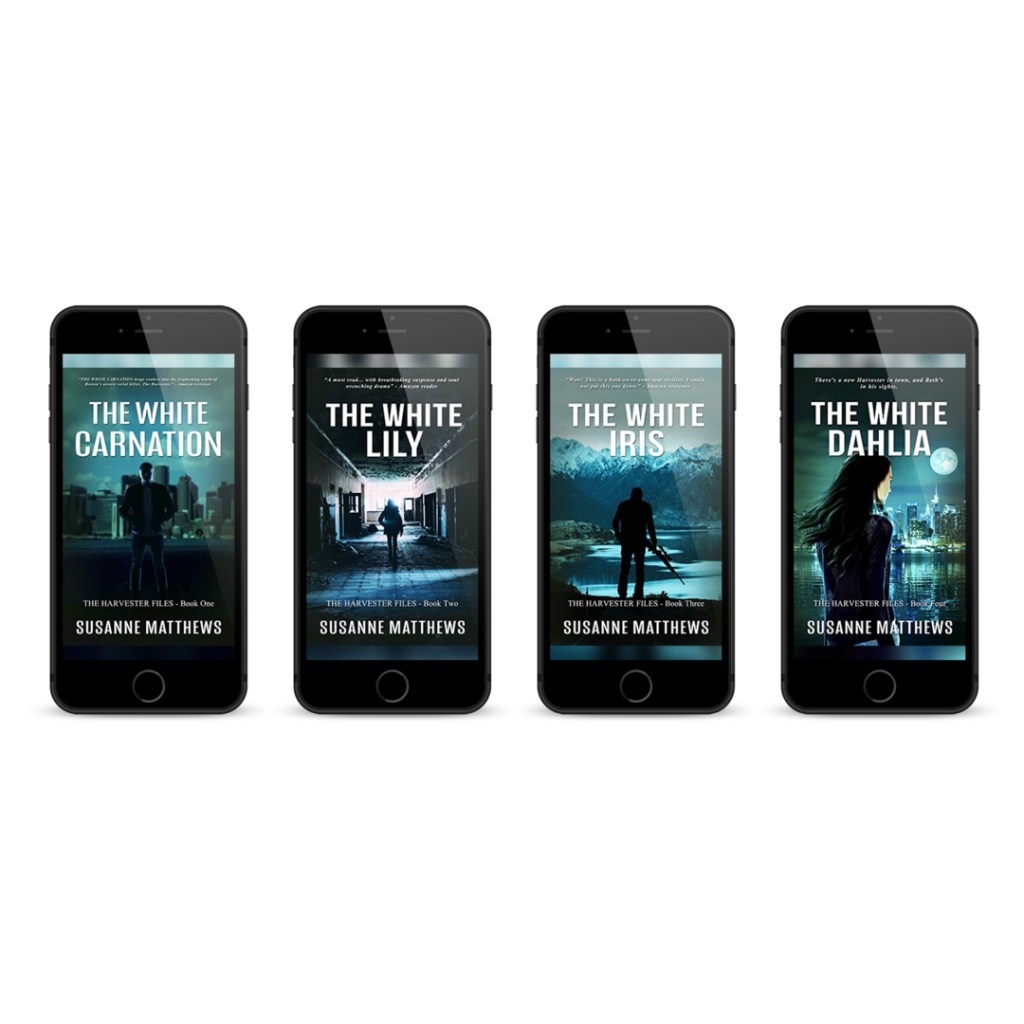
For example, my Harvester Files, The White Carnation, The White Lily, The White Iris, and The White Dahlia have similar covers and titles and should be read in order to get the most out of the series. The covers are dark, and eerie, befittng the stories. If you look closely, the covers have two men and two women on them, depicting the main “hunter” in each story.
Each book, while an individual strory, contains recurring characters, but what links them is the fact that in each book, the detectives are on the hunt for a vicious serial killer, each of them controlled by a cult leader with his own plans for the future. In each book, the team gets one step closer, the titles are explained, and someone gets a happily ever after. Writing thrillers takes a lot out of an author, so I generally add a few lighter stories in between.
Among my lighter pieces are my contemporary romances. Here are five of my six Cocktails for You series books, Tequila Sunrise, Champagne Cocktail (a Christmas book not pictured), Buck’s Fizz,The Tipsy Pig, Make Mine a Manhattan, and Emerald Glow, These books can be read in any order. The first three books are novellas, shorter than the later ones. The seventh book, Sea Breeze is currently being written, and will be available in paperback in early March, with the ebook out in the fall. The eighth, Pumpkin Spice will be available in paperback in August and in ebook in October These books, all based on a particular cocktail, are written in the first person, the only series of mine that is. They are contemporary romantic comedies, some sweet, others spicy. Each is a slice of life for the heroines as they search for and find their Mr. Rights. While some get happily ever afters, each gets a happy for now! Unlike my darker suspense novels, the plots are shorter and more linear. If you’re looking for a feel good story, then these are the books for you.
Following on the heels of my Harvester Files series is the Vengeance Is Mine Series. On His Watch, Fire Angel, In Plain Sight, No Good Deed, and Secrets and Lies, are all standalone stories that can be read in any order. These books are linked by the theme. In each book, the antagonist is out for revenege, and it’s up to the protagonist to keep the heroine from meeting the fate the villain is intending for her. These books are complex novels, with disturbing story lines designed to keep you on the edge of your seat. In each book, the hero and heroine face what seem to be insurmountable odds as they deal with injuries that change them in some way. dealing with imperfect heroes who will do whatever they can to protect the women they’ve come to love. A disgruntled FBI agent, an arson investigator, a blind pianist, a washed up police detective, and a high school principal–unlikely heroes who prove that good and love do triumph in the end.
While writing those books, I wrote lighter contempoaray romance to cleanse my soul. After my ad course, I realized these books needed a makeover and i gave them one, carefully examining what made these books a series, From that examination came my newest series An All For Love Book, which links some of my contemporary romances together. The books are Just For the Weekend, Wedding Bell Blues, The Blue Dragon, Forever and Always, and Same Time Next Year. What links these stories are their themes–each is a second chance at love story, complicated by secrets that could destroy their relationshps. Here’s the series blurb: Falling in love isn’t always easy, and for the couples in these books, the road to happiness is often complicated and filled with misunderstanding that can last days, weeks, months, years, or even decades. But in the end, love triumphs.
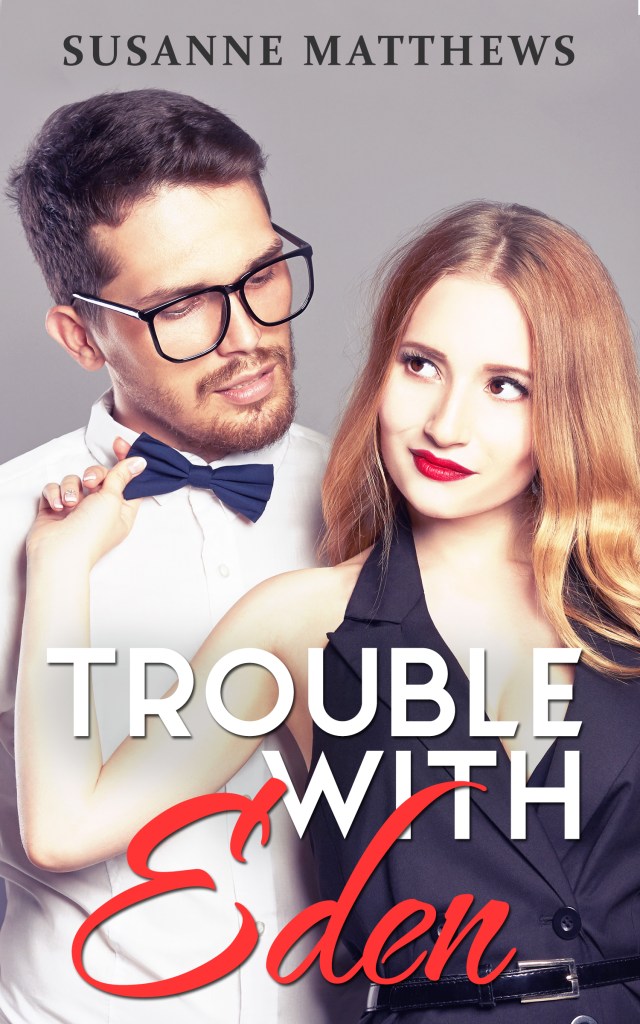
These books can be read in any order, and they are all looking good in their shiny new covers and revamped blurbs. The sixth book in the series, Royal Flush is available in paperback only for now, but the ebook is on pre-order, with its release date set for the end of May. The seventh book, Trouble With Eden will be available in paperback in April and as an ebook in August.
I have other collections available, some hoistories and other holiday romances. You can find links to all of these and more books on my website. https://mhsusannematthews.ca/
If you have read one or more of my books, take the time to review them on Amazon. Reviews make a huge difference to the life and popularity of a book.
Welcome to this week’s Tuesday Tales. Hard to believe we’re less than a week away from Valentine’s Day! Do you have plans with your significant other? This week’s word prompt is STOOP. This is the last post from this story. Next week, I will have something new to share with you! How do you like the cover? Seeing my characters always makes writing about their adventures easier. Enjoy!
She was out on the stoop, waiting for Kyle when she realized she’d forgotten to put her brown contact lenses back in. Wearing them all day made her eyes sore, and she’d taken them out when she’d showered, hoping to give them a break. Before she could retrace her steps, Kyle’s Porsche turned the corner. Maybe he wouldn’t notice that her eyes were more green than brown tonight. If he were color blind, and one in twelve men were, it wouldn’t be an issue. The car slid to the curb before she could do anything.
Kyle got out of the vehicle and came over to her, carrying a box of chocolates.
“These are for you.” He extended the gift toward her.
She stared at the box. No one had ever given her candy. She swallowed the sudden emotions threatening to choke her.
“Thank you. That’s so nice of you. I love chocolate. It’s my fatal weakness.” If her smile were any wider, it would split her face.
“I’m glad that I ‘chose wisely.’ These are maple creams made with syrup from our trees. Ben tells me they’re delicious. You’ll have to give me your opinion.”
“I will. Let me run them upstairs so that they don’t melt in the car. I won’t be long.”
She rushed up the stairs and opened her door, the one closest to the street, placed the chocolates on the table inside, and relocked the door. Should she have opened the box in front of him, offered him one? She was at a loss here.
“Thanks again,” she said. “No one’s ever given me chocolate before.” She smiled, unable to tamp down her happiness.
“I find that hard to believe. Sweets for the sweet as they say. By the way, you look great,” he said. “Your hair down like that suits you, but I can see that style probably isn’t practical at work. Ready for action and adventure?”
“Definitely … and hungry, too. Where did you plan to feed me? Not at Veggie Planet I hope.” She made the same face she had when she hadn’t liked one of the beers the other day. “Not a fan.”
Kyle laughed. “No, the adventure will all be in the movie. I’ve got something with a little more atmosphere in mind for dinner.” He opened the passenger door for her. “Ever been in a Porsche before?”
That’s it. Stay safe and don’t forget to check out the other Tuesday Tales
Good morning! It’s hard to believe that it’s already February. My January was messed up when we went into lockdown again, but what really disrupted my life was Omicron. Yup, three vaccines and I still got it, but I wasn’t severely ill. I had a bad head cold and a post-nasal drip cough. Since I’m an asthmatic and immunosuppressed. it could’ve been a lot worse than it was. Thank goodness for vaccines. I’ll take as many as they want to give me. My 94 year old mother has just had her fourth! Sadly, my daughter’s friend’s mother, who is my age, also got sick, but unlike me is unvaccinated. She is still in the hospital and if and when she recovers will require supplemental oxygen for the rest of her life. Yes. People have choices. Sadly, they don’t all make the right one.
This month’s blog question is an easy one for me to answer. February 2 question – Is there someone who supported or influenced you that perhaps isn’t around anymore? Anyone you miss?
The person who supported my writing career and is no longer with us is my father. He passed away in 2019, at 91, after a fall. My dad was a fun-loving man with a great sense of humor and a wonderful imagination. When I was a child, he used to tell me wild stories about the adventures of Tarzan or Jungle Jim. Since I was a picky eater, while he described hair-raising situations, I would gobble up all my dinner.
When I wrote my first book, he couldn’t brag about it enough. He read it and his praise gave me the courage and incentive to write another, and then another. He enjoyed all of my books but his favorite was On His Watch.
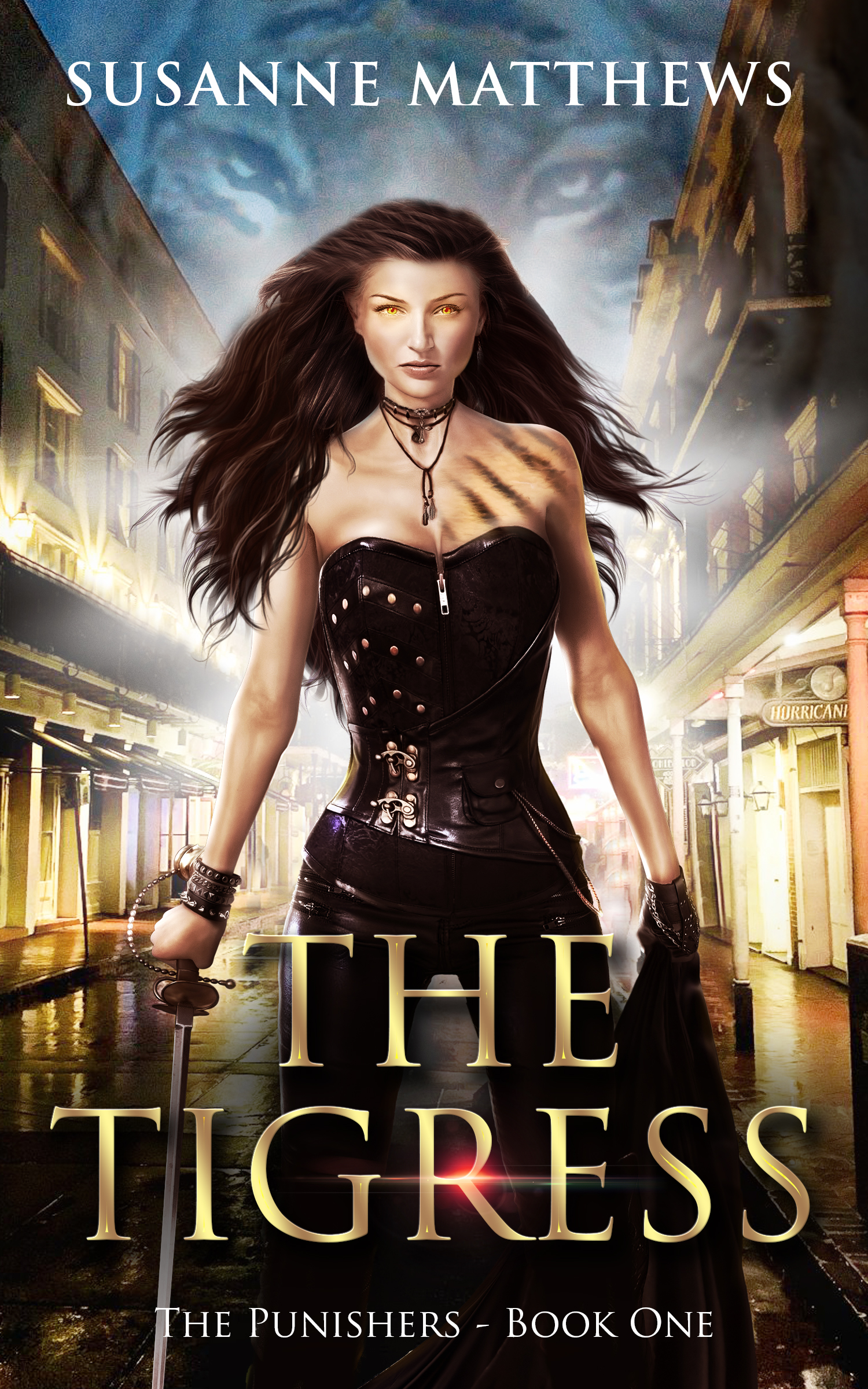
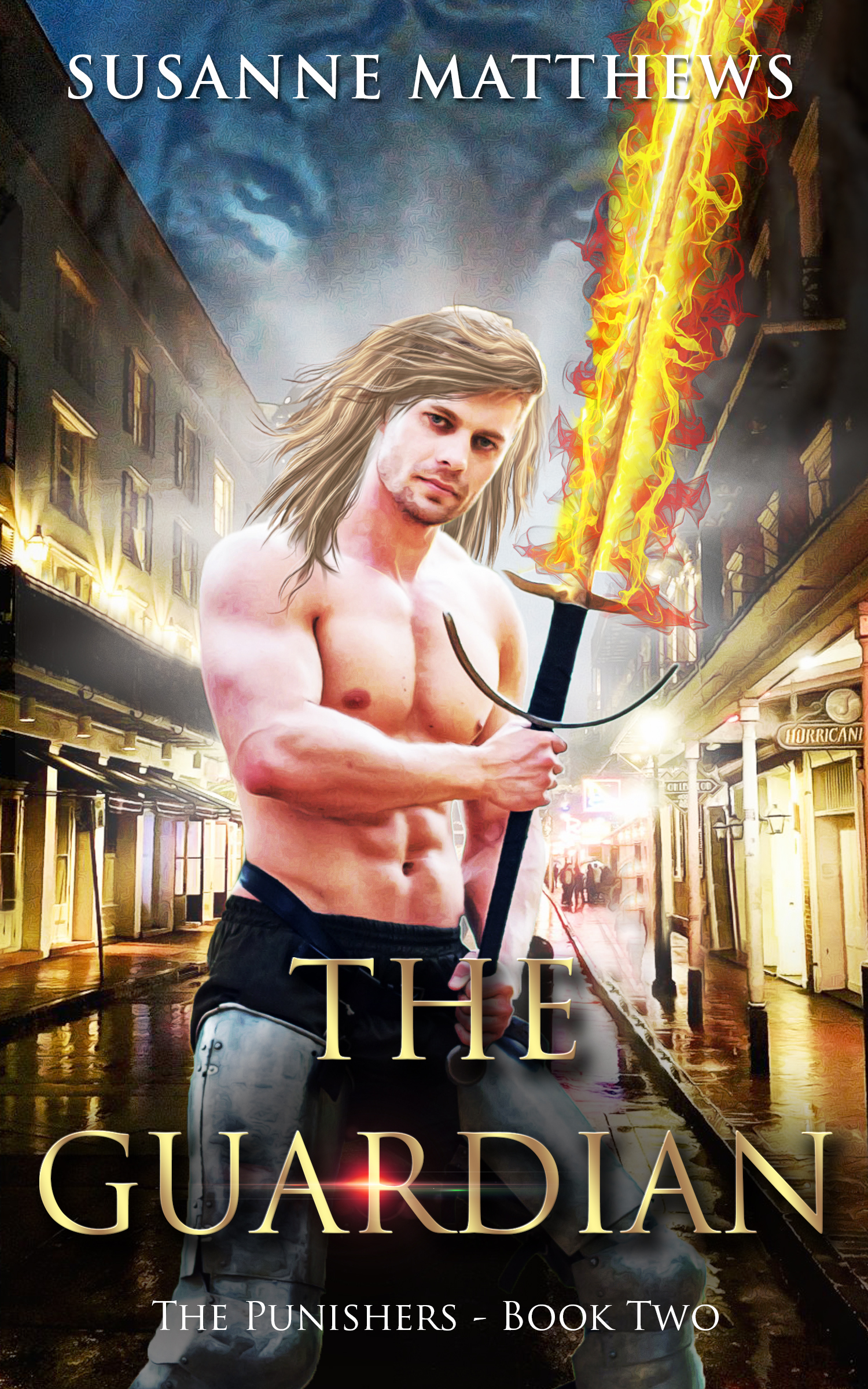
Just before his fall, Dad convinced me to try my hand at writing a paranormal detective story. He enjoyed books about vampires and the supernatiral, but also loved detective/police procedural stories. I’d just started the first book when he had his accident. On the good days in the hospital before pneumonia set in, I would talk about the developing plot line, and he would smile, nod his head, and say “that’s going to me a good one.” When he died, I was devastated but determined to finish his book. The Punishers are a team of immortals who work for the NOPD to protect New Orleans’s immortal and mortal populations from rogue vampires, witches, bokurs, demons, and whatever else I throw at them. They consist of a rakshasa who can assume the shape of a tigress, a peredhil, a half-elf who wields a magic sword, a vampiress, and a shape-shifting bear. With the help of a Vodun priestess, a witch, and other supernatural creatures, they keep New Orleans safe.
Paranormal/fantasy
There isn’t a day that goes by when I don’t think of my dad. This year, I’ll add book three to the series.
Wow! It’s the end of January already. Lots has happened in the first month of the year. While I’m triple vaxxed. I still came down with COVID 19. I wasn’t severely ill, although the cough did linger a few weeks. Glad that was all there was to it. Thank goodness for the vaccines.
Welcome to this week’s edition of Tuesday Tales. I’m contiuing with Royal Flush, my contemporary romance. Our word prompt this week is RUNNING.
Enjoy!
“I think you’ll like this place. It’s very popular with the tourists. It’s on a couple of microbrewery tours. If you want to, you can go inside and have a look at the brewery, but it would be rather warm in there today.”
“Maybe another time.”
They stood at the closed patio gate, waiting for the host or hostess.
“Hi, Pearl,” the hostess said, her broad smile visible through her transparent mask. “Long time no see.”
“It’s been a while, Melody,” she agreed. “I like your mask. It looks like the place is busy today.”
The redhead eyed him as if he were a slab of meat, and she was starving. “I haven’t seen you around here,” she purred, standing straighter, allowing her tight t-shirt to strain across her chest.
Seriously? The girl was barely legal. Besides he was quite happy with the one he was with.
“I haven’t been around. Table for two?”
Melody, as Pearl had called her, got the message, shrugged, and showed them to a table near the creek, the sound of the running water all but obscured by the music coming over the speakers.
“What’ll you have?” she asked, not quite ready to give up on him.
He turned to Pearl, “What do you suggest?”
“How about two samplers?” she asked. “You get to taste the six brews on tap for five dollars and then choose the one you liked best for a full pint afterward.”
“Sounds good,” he answered, smiling at the waitress to take the sting out of his rejection of her. He wanted his beer today, and if she weren’t happy with him, that could affect the service.
“Nice place. Come here often?”
Pearl shook her head. “No. Melody used to work at the diner with me. Apparently she figures the tips are better when alcohol’s on the menu. I was here for the first time a few weeks ago with Maggie and Dwayne for Blair’s husband David’s birthday.”
Melody delivered the wooden slabs on which sat six two ounce glasses of beer. “The dark one’s the stout, the one at the opposite end is the wheat beer. The others are numbered and can be ordered by the number. It’s Happy Hour, so you get whichever pint you would like for half-price.”
“Thanks,” Kyle said.
Melody nodded and went off to serve someone else.
That’s it. Stay safe and don’t forget to check out the other Tuesday Tales
Welcome to this week’s Tuesday Tales. This week our word prompt is ROCK. I’m continuing with Royal Flush, my contemporary romance.
“I hope you don’t mind, but yesterday I asked Maggie when you wrapped up for the day.” He grinned. “If you aren’t too tired, I thought we might grab a drink and finish our conversation. There is someplace in town that sells cold beer, right?”
She chuckled, secretly pleased he’d thought enough to ask and wanted to spend more time with her, but determined not to let him know it.
“There is, but I wasn’t aware we had a conversation to finish,” she parried, playing the coquette even though she wasn’t particularly skilled at it.
He covered his heart with his hands. “Ouch! That hit the bullseye. I’m mortally wounded.”
She fought to keep her laughter in check. “Sure you are, but since I’m thirsty, you can buy me a beer at The Brew Shack. Their patio runs along the creek, separated from the water by a low, rock wall. It’s in the shade at this time of day and guaranteed to heal all mortal wounds.”
He grinned and offered her the crook of his arm. “In that case, lead on. I’m not sure I remember where it is.”
“It’s only been open a couple of years,” she explained, putting her arm through his and walking along the sidewalk with him, secretly cherishing the smiles on the faces of those they met, with their “Hi, Pearl” and “Welcome back, Kyle,” as if they approved of them as a couple. The prince and the pauper—if only they knew the truth!
She loved every inch of this town, even though it was as different from what she was used to as night and day. Hollywood Boulevard and Rodeo Drive had far less appeal for her than Main Street. They walked by Aunt Ida’s Quilt Shop, closed on Tuesday so that the woman could play bridge. Next to her store was The Blushing Bride and Groom, a “by appointment only” wedding boutique since each of the garments Agnes Getz sold was handmade. On the corner of Main and Colchester stood Martin’s Antiques and Collectables.
“Have you ever been in there?” she indicated the place. “They have some truly unusual items.”
“Yes. A couple of times. I think every kid who grew up in Forest Falls went down there on a dare at one time or another. A lot of them think the place is haunted. What about you? Have you tempted fate yet?
That’s it. Stay safe and don’t forget to check out the other Tuesday Tales
Welcome to this week’s Tuesday Tales. Since our prompt is a picture, we’re limited to 300 words. I’m continuing with Royal Flush, my contemporary romance. Here’s the picture I chose.
Pearl liked finishing at three. It gave her time to explore the area before calling it a night. She’d picked up a used bike—only three gears—and often rode down to the creek as the locals called it. It was actually a small tributary off the Winooski River. There was a spot where a lot of the locals went swimming, and on a hot day like this, a swim sounded inviting. Maybe she’d been a small town girl in another lifetime, but as much as she would love to stay here, eventually, reality would intrude, her father’s mercenaries would find her, and she would have to go home.
Going into the breakroom, she stuffed her dirty apron into the laundry hamper, removed her uniform and hung it in her locker, slipped off her loafers, shoving the footies she’d worn inside a baggy and then into the side pouch on her messenger bag. After spritzing herself with a lightly fragranced body spray, she dressed in walking shorts, a sleeveless blouse, and sandals. She removed her hairnet, yanked the elastic from her hair and brushed out her curls before scraping them back into a high ponytail. She’d toyed with the idea of getting it cut short, but since she couldn’t remember the last time she’d had it short, it might not be a good idea. Grabbing her messenger bag and sunglasses, her mask still in place, she headed home for the day.
Finding Kyle sitting on the bench outside the diner was a surprise. He stood as the door closed behind her. She removed her mask and smiled.
“Fancy seeing you here,” she said. Was he waiting for her? The tiredness from moments ago vanished.
That’s it. Stay safe and don’t forget to check out the other Tuesday Tales











 Living the Dream